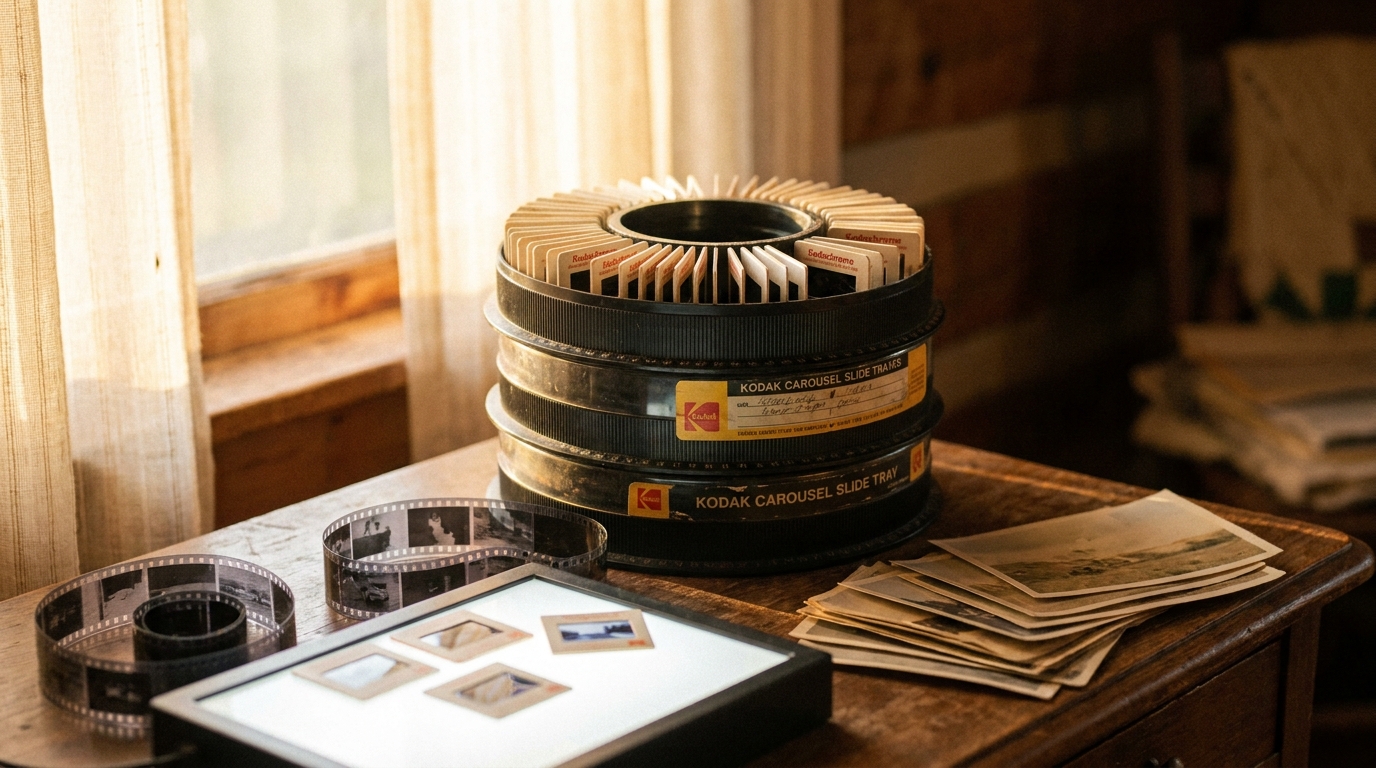
Eighty 35mm mounts in a Kodak Carousel Transvue 80, and 140 in a Carousel Universal 140. The capacity is stamped on the physical tray itself, so read it rather than guess, then adjust for empty slots, because a projector magazine or carousel arrives half full more often than not. Ten carousels is therefore 800 to 1,400 slides at capacity, not the “few hundred” most people assume.
Looking for the Instagram carousel post limit? This page is about physical slide trays, not social posts.
That adjusted slide count is also the number that matters if you ever have the collection scanned. Cost, turnaround and whether culling first is worth your evenings all follow from that one number, and current rates are on our pricing page.
| Tray type | Slots | Typical real-world fill |
|---|---|---|
| Kodak Carousel Transvue 80, and the Ektagraphic Universal in its 80-slot form | 80 | Around 60 to 75, with gaps where slides were pulled for framing |
| Kodak Carousel Universal 140, and the Ektagraphic Universal in its 140-slot form | 140 | Around 100 to 130, since thicker mounts jam a fully packed tray |
| Straight magazines: Leitz, Braun, Rollei, Agfa and Reflecta | 36, 40 or 50, printed on the end | Often near full, because they were loaded per event |
| Stack loader | No fixed capacity, roughly 35 to 40 mounts at a time | A holding tray, not storage, so count the box it came from |
Read the capacity printed on each tray, apply the fill rate you see when you spot-check three or four, and you have a count good enough to quote against. If you would rather not, get a quote from your carousel tray count.
As of 2026: the tray-capacity guidance on this page was last reviewed in September 2026. The 80-slot and 140-slot figures are moulded into the trays themselves and do not change; what we refresh is the real-world fill ranges we see at intake and the counting method behind them.
- Capacity is printed on the tray. Check it rather than estimating.
- Trays are the wrong billing unit. Slide count is the right one.
- Slides already in trays are already sorted, and that order is worth keeping.
- Culling frame by frame costs more of your time than it saves in scanning.
How many slides does a standard Kodak carousel hold?
A Kodak Carousel Transvue 80 holds 80 slides, and the capacity is stamped on the tray itself. The Ektagraphic Universal, sold for the Ektagraphic projectors, comes in both 80-slot and 140-slot versions and is marked the same way. That number is its capacity, not its contents. Most trays come in with gaps where someone pulled a favourite for framing decades ago and never replaced it.
So do two passes. Multiply trays by capacity for a ceiling. Then eyeball three or four trays and estimate what fraction of the slots are loaded. Twelve 80-slot trays at roughly three-quarters full is around 720 slides, not 960. That gap is real money.
Is a carousel tray a billing unit?
People arrive assuming a carousel is priced like a box or a reel. It is not, and any lab that treats it as one is guessing at your expense.
Tray-based labs bill one line item per tray; we bill per image through the scanner, and the count that meets any minimum is scanned originals rather than containers. A tray holding 22 slides and a full tray are the same charge to a tray-based lab and many times apart in actual work. Ask any lab you are comparing how they handle a half-empty tray. The answer tells you what you need to know.
How do you count loose slides, boxes and the yellow cardboard?
Almost no collection is all carousels. There is usually a parallel stash: original processing boxes, a shoebox of loose mounts, a plastic file case bought in 1988 and filled halfway. Start from how many slides fit in a carousel tray, then add the strays to that total.
Processing boxes are easy because they were sold by the batch. For loose slides, measure instead of counting: standard 2mm cardboard mounts run about 12 to 13 to the inch, so stand the mounts on edge in a box, count the inches of stack depth and multiply by 12. Crude, but it produces a quoting-grade number in minutes rather than an evening of counting. Thicker plastic and glass mounts run fewer to the inch, so count an inch of those yourself before multiplying. Culling and resolution both come after the count, and both are covered in the section below.
If your slides are in trays, leave them there. That order is a decision someone in your family made deliberately, often for a specific evening’s slideshow. Trays are rigid and hold each mount separately, so they ship well. Tipping the trays into a bag to save shipping volume destroys information you cannot rebuild.
Beyond the tray count: culling, resolution and condition
Everything above answers the capacity question. What follows is the secondary material people ask about once they have their number, kept separate so it does not muddy the count.
Should you cull first?
This is the question that stalls collections for years. Someone buys a light box, does two trays, and the project stops there.
The honest maths: reviewing a slide properly takes longer than scanning one does. To cull you hold each slide to a light, decide, and re-sort. To scan, it goes through a feed. You would be trading a large stack of evenings for a modest reduction in count.
Two cases where culling genuinely pays. Bulk duplication – forty near-identical shots of the same cathedral, where one decision clears a whole run. And material that is not photographs: title slides, blank frames, test exposures, lecture charts. Both pull out fast because the decision is made in blocks.
How many slides fit in a 140 tray?
A Carousel Universal 140, or an Ektagraphic Universal in its 140-slot form, holds 140 slides, and in practice arrives holding around 100 to 130, because thicker or warped mounts jam a fully packed tray. Treat 140 as the ceiling and spot-check the fill before you quote against it.
Should you cull at the tray level, not the slide level?
Pull entire trays you know are work presentations or a colleague’s holiday. Do not go frame by frame inside a family tray. Block decisions take an afternoon; frame decisions are how a project dies.
What scanning resolution should you pay for?
The instinct with a big collection is to buy the biggest number on the menu for everything. For a 35mm frame that instinct is half right and expensive.
Scanning resolution for slides is normally offered in tiers, and the jump from a mid tier to a high tier roughly doubles the linear resolution, which quadruples the pixel count and the file size. On film that has real grain-level detail – a sharp, well-exposed original on a tripod – the higher tier shows you something. On a hand-held snapshot on aged stock, the extra pixels mostly record grain and scanner noise at four times the storage. We do not publish a fixed tier menu here, because the resolution we choose is set by what each original can actually resolve rather than by a number on a price list, and a soft 1970s frame scanned enormous gives you a large file and no more detail.
The practical rule for a mixed collection: put the resolution budget on slides and negatives, which are camera originals, and be more restrained with prints, which are reproductions – unless the print is the only surviving copy, in which case treat it as an original too. Ask your lab which tiers they offer and what megapixel figure and file size each produces from a 35mm frame, then decide once for the whole collection rather than tray by tray. Tier choice only turns into a budget once you know how many slides fit in a carousel tray and how many trays you have.
For what happens to a tray between intake and return, see how carousel trays are logged, scanned in tray order and returned.
What does fading do to Kodachrome and Ektachrome slides?
The two big slide stocks age differently, and it changes what you get back rather than what you should send.
Kodachrome stored dark in a tray holds its colour remarkably well. Trays sitting in a cupboard since the seventies often scan with very little correction. Ektachrome and the other E-6 stocks shift more, usually towards magenta or a general muddiness, and take more correction work. Either way the quote starts from the count, so if you are still working out how many slides fit in a carousel tray, settle that first.
Know this before you cull. A slide that looks dead on a light box is frequently recoverable in a scan. Fading is not loss. Do not bin a tray because it looks pink.
Prints, negatives and slides are three different jobs
| Format | Usually arrives as | Counting method | Main handling issue |
|---|---|---|---|
| Slides | Carousels, processing boxes, file cases | Tray capacity, adjusted for empty slots | Warped and glass mounts |
| Negatives | Sleeved strips in envelopes | Strips per envelope times frames per strip | Curl and surface debris |
| Prints | Shoeboxes, albums, sticky-page books | Measured stack depth or album pages | Fragility, adhesive, surface texture |
Prints are where handling method matters most. Anything brittle, torn or stuck to an album page should be treated as fragile from the outset rather than fed through equipment built for stacks of stable modern photos.
What actually happens once your trays arrive?
Less dramatic than people imagine. The parts that protect your collection sit either side of the scanner, not in it.
- Intake and count, so every tray and box is logged and the collection can be reconciled at the end.
- Condition check, separating warped, taped, glass-mounted or shedding mounts for hand handling.
- Scanning in tray order, so the family’s sequence survives into the filenames.
- Colour correction pass, which earns its keep on faded E-6 stock.
- Reconciliation against the intake count before anything is packed for return.
The count at the front and the count at the back are the boring steps that make the difference. Twenty-five years of running our own lab has taught us that nothing is lost in a scanner; things are lost in the moments between one container and the next.
FAQ
How many slides fit in a Kodak carousel?
The Carousel Transvue 80 holds 80 slides and the Carousel Universal 140 holds 140; the Ektagraphic Universal was made in both sizes. The capacity is moulded into the tray, so read it rather than guessing, because the two sizes look similar on a shelf. In practice most 80-slot trays come in holding around 60 to 75, and the 140s closer to 100 to 130, because thicker or warped mounts jam a fully packed tray.
Why is a carousel tray rarely full?
Because slides were pulled out over the years for framing, for a school project, or for a second tray, and rarely put back.
How many slides fit in a straight-line magazine?
Thirty-six, 40 or 50 slides, with the number printed on the end of the magazine. Leitz, Braun, Rollei, Agfa and Reflecta straight magazines are the ones most often in the box. They tend to be close to full, because they were usually loaded for one event rather than topped up over years.
Does a partly filled tray change anything?
It changes your count, not the capacity marked on the tray. A tray holding 22 slides is a fraction of the work of a full one, which is why the billing unit matters; see the section above on whether a carousel tray is a billing unit.
Do I need to take my slides out of the carousels before sending them?
No, and generally you should not. Tray order reflects how someone chose to sequence a slideshow, and that sequence is worth preserving. Emptying trays into a bag saves a little shipping volume and loses information you cannot recover.
Should I sort through my slides before scanning them?
Only in blocks. Pulling whole trays of work presentations or obviously non-family material is quick and worthwhile. Going frame by frame inside family trays takes longer than scanning does, and it is the most common reason a scanning project never finishes.
Are faded slides still worth scanning?
Usually yes. Ektachrome and other E-6 stocks shift with age, often towards magenta, but a shifted slide still holds its image and a colour correction pass recovers a great deal. Kodachrome stored dark often needs almost none. Do not discard a tray because it looks pink on a light box.
How do I count loose slides that are not in trays?
Measure rather than count. Standard 2mm cardboard mounts run roughly 12 to 13 to the inch, so measure the stack depth in inches and multiply by 12. Approximate, but it gives you a quoting-grade estimate in minutes instead of hours. Plastic and glass mounts are thicker, so count an inch of those yourself before multiplying.
Is a higher scanning resolution always worth paying for?
For slides and negatives, higher resolution pulls genuine detail out of a camera original. Doubling the linear resolution quadruples the file size, so on a hand-held snapshot the extra tier mostly records grain. For prints the ceiling arrives sooner still, because you are scanning a reproduction. On a mixed collection, spend the resolution budget on the film.
How long does a ten-carousel collection take to scan?
Turnaround depends on the lab’s current queue and on how much hand handling your mounts need, so ask for a window in writing at quoting time rather than assuming. A collection with many glass or taped mounts moves slower than one of clean cardboard mounts, because those frames are handled individually.
Is this about Instagram carousels or slide projector trays?
Projector trays. If you are after the Instagram carousel post limit, that is a social media question and a different page; everything here is about physical 35mm slide trays, magazines and the mounts inside them.
How many slides are in ten carousels, in practice?
Ten carousels is 800 to 1,400 slides at capacity, depending on the mix of 80-slot and 140-slot trays, and nearer 700 to 1,000 once you allow for empty slots. Say ten trays and two shoeboxes.
Read each tray’s capacity. Spot-check the fill on three or four and apply that fraction to the whole shelf. If eight are 80-slot trays and two are 140s, running roughly three-quarters full, you are near 720 slides, plus whatever the shoeboxes hold once you measure them.
Then pull any trays that are clearly not family material, leave everything else in tray order, and get a quote on the slide count rather than the tray count. Ask for the rate and the expected turnaround window in writing before you ship, so 720 slides is an arithmetic problem you can check rather than a number you are handed. Our current rates are published.
That is the whole job on your side: a weekend of counting, not a year of feeding a home scanner. What changes afterwards is simple. The trays stop being a task on a list and become something you can actually look at on a screen with your family, in the order someone meant them to be seen.